Why a Traffic Data Platform?
Why is an explicit traffic data management platform required? Are there special requirements that make it inevitable to use a specialised platform? Why not just store and process the data locally?
Benefits and Use Cases
- Long-term recording: Critical traffic scenarios are rare. Months of continuous recording are needed to capture enough examples of accidents, near-misses, or unusual patterns.
- Time-aware analysis: Traffic behaviour differs by hour, weekday, season, and special events. Queries must be fast across large time ranges, which requires a time-series-optimised database.
- Live and historical in one place: Operators need a real-time view for monitoring and alerts AND historical data for research, reporting, and validation.
- Inspect individual encounters: Follow a road user across the map, switch to their perspective with Ego view, and slow down historical playback to examine an interaction or braking manoeuvre. See the Location Page for the controls.
- Multiple sources, one interface: Cameras, detector loops, GPS trackers, and weather stations produce different formats. A platform normalises and integrates them into a single queryable store.
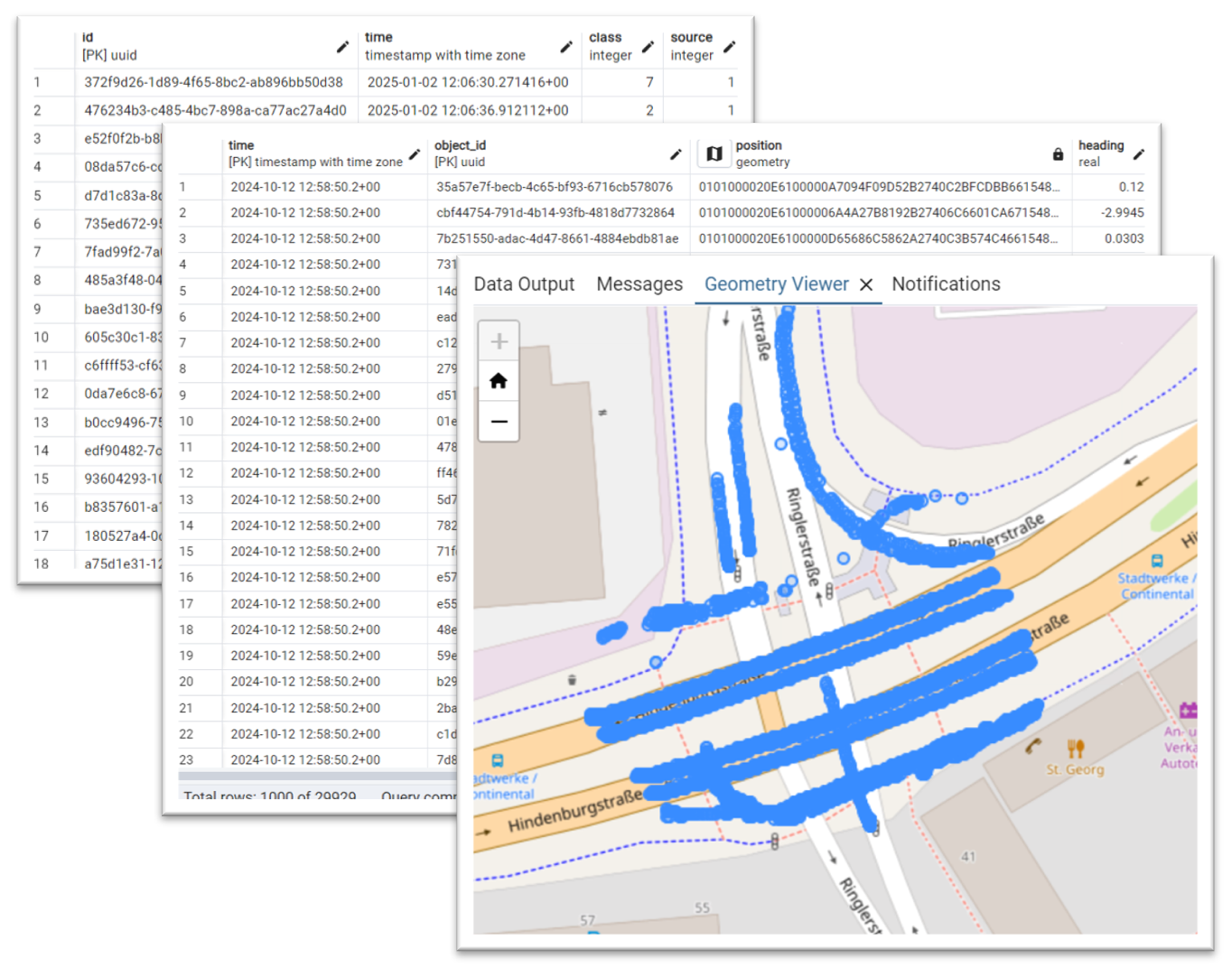
- Spatial queries: Trajectory data is inherently spatial. Counting objects crossing a line, finding all events within a polygon, or clustering stop points requires PostGIS-level geometry support.
- Compression and Retention: Raw high-frequency data grows quickly. Automatic compression and retention policies keep the database lean and performant without manual intervention.